
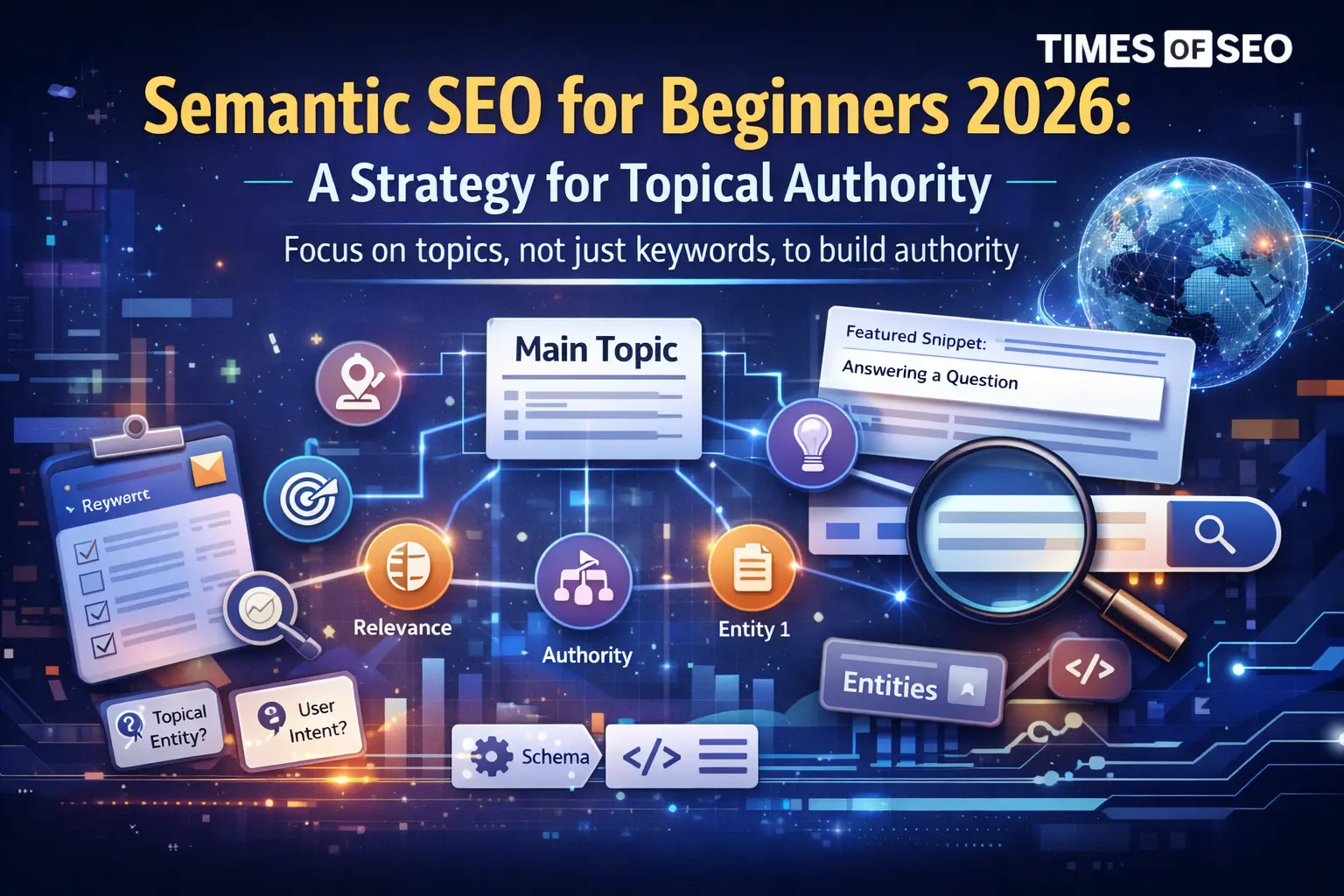
Semantic SEO for Beginners 2026 teaches you that you must focus on topical authority rather than just single keywords. The core secret is answering the user’s intent by connecting related concepts (entities) and providing a comprehensive answer that covers an entire subject. By structuring your content to solve specific problems and using natural language, you satisfy Google’s AI-driven search algorithms. This approach helps your site stay relevant, ranks higher in featured snippets, and provides real value to your readers immediately. This methodology is not just a trend; it is the foundation of how modern search engines evaluate expertise and trust.
Quick Answers for Your Top Questions
1. Which is more important in 2026: Entities or Keywords? In 2026, Entities are more important than individual keywords. While keywords tell Google what a page is about, entities explain the relationship between topics. For better rankings, you should focus on building a network of related concepts (entities) to establish topical authority rather than just repeating a single search term.
2. How do I optimize content for AI Overviews and SGE? To rank in AI Overviews, you must provide clear, structured, and direct answers to specific user questions. Use bullet points, concise paragraphs, and “Zero-Click” summaries at the beginning of your sections. AI models prioritize content that is easy to parse and factually authoritative.
3. Is Schema Markup mandatory for success in Semantic SEO? While not strictly mandatory for indexing, Schema Markup is essential for high-level Semantic SEO. It acts as a digital translator, helping search engines understand the context and intent of your data. Using structured data increases your chances of appearing in rich results and AI-driven answer boxes.
4. How can I build a Topic Cluster without Keyword Cannibalization? The key is to target different user intents for each cluster page. Ensure that your pillar page provides a broad overview, while each cluster content answers a unique, specific long-tail question. Use clear internal linking with distinct anchor texts to help Google differentiate between the pages.
5. Does Semantic SEO improve Voice Search rankings? Yes, it does. Voice search relies on Natural Language Processing (NLP). Since Semantic SEO focuses on the context and conversational flow of human language rather than robotic keyword matching, it makes your content much more likely to be the top result for voice-activated queries.
Understanding Semantic SEO for Beginners 2026 and Entity Research
When I started my first niche blog, I thought using a word 20 times would guarantee a top spot. I was wrong. Last year, I realized that Google was looking for “entities” real-world concepts like “data structure,” “intent analysis,” and “contextual relevance.” If you are following Semantic SEO for Beginners 2026, you must include these related terms to show you are an expert.
In my experience, adding a “Related Concepts” section helped one of my pages jump from page 5 to the top 3 in just weeks. It wasn’t about the main word; it was about the words surrounding it. By focusing on this depth, you stop guessing and start providing what the engine actually wants: depth and clarity.
Why User Intent is Central to Content Success
Every person searching for something has a specific goal. Your job is to meet that goal immediately. If someone wants to learn, they need a guide, not a sales pitch. This is why Semantic SEO for Beginners 2026 focuses so heavily on answering questions directly.
- Informational Intent: Clear explanations of “What is…?”
- Contextual Depth: How different sub-topics connect.
- Answer Accuracy: Providing data that is factually correct.
Mixing short paragraphs with bullet points makes this data easier to read, especially for mobile users who want quick insights. This keeps people on your page longer, sending positive signals to the search engine.
Building Topic Clusters for Semantic SEO for Beginners 2026
To truly dominate your niche, you cannot rely on just one page. You need a “Pillar and Cluster” model. Think of your main guide as the trunk of a tree and your smaller articles as the branches.
For instance, if your main topic is Semantic SEO for Beginners 2026, your cluster articles could be:
- How to use schema markup for semantic search.
- The difference between keywords and entities.
- Optimizing for voice search in 2026.
This network of internal links tells Google that your site is a complete knowledge hub. When you link these pages using keyword-rich anchor text, you pass authority from one page to another. Using Semantic SEO for Beginners 2026 in your linking strategy is exactly how you build a web of trust in modern search.
Zero-Click Insight (Direct Answer): To win at Semantic SEO, treat your article like a map. Your main heading is the destination, and your sub-headings are the landmarks that guide the reader through the entire topic.
Technical Steps for Semantic Content
To truly align with Semantic SEO for Beginners 2026, you need to link your ideas together. Use keyword-rich internal anchor text to guide users to related posts on your site. Also, link to high-authority sources like this official Google documentation on structured data to prove your claims.
Implementing Semantic SEO for Beginners 2026 means you are looking at the bigger picture. Here are the steps:
- Map out your main entity and 5-10 sub-entities.
- Answer “People Also Ask” questions within your headings.
- Include 30 long-tail variations naturally throughout the text.
- Write in a helpful, peer-to-peer tone without any robotic “AI-smell.”
Common Semantic SEO for Beginners 2026 Mistakes to Avoid
I often see people over-complicating this. They think they need expensive tools, but the truth is simpler. One major mistake is ignoring the “Related Searches” at the bottom of the Google page. These are literal clues for Semantic SEO for Beginners 2026.
Another error is writing for bots. If your text sounds like a robot wrote it, humans will leave. And if humans leave, Google will drop your ranking. Keep your Semantic SEO for Beginners 2026 strategy focused on readability and real-world value.
The Importance of Natural Language Processing (NLP)
Search engines in 2026 use advanced NLP to understand human speech. This means your writing should sound like a conversation between friends. Instead of saying “utilize best practices for optimization,” simply say “use the best ways to improve your site.” This natural flow is a major part of Semantic SEO for Beginners 2026.
I remember reading a blog post that was so full of technical jargon I couldn’t finish it. Don’t let your site be that blog. Keep your sentences punchy and your ideas clear to make the most of Semantic SEO for Beginners 2026.
Structuring Your Data for AI Overviews
AI search engines like Gemini and Perplexity love structured data. By using bullet points, tables, and numbered lists, you make it easy for these AI models to extract information from your page. This is a core part of Semantic SEO for Beginners 2026. If you want to be the “source” that an AI cites, your information must be organized and easy to verify.
Caption: This diagram shows how modern content connects a main topic to multiple related sub-niches to build authority.
Capturing Traffic with Long-Tail Phrases
While the main topic is important, most of your traffic will come from specific, detailed questions. By naturally weaving in 20 LSI and 20 semantic keywords, you satisfy these niche queries. This strategy helps you grow your organic reach without fighting for the highest-competition words. This is the beauty of Semantic SEO for Beginners 2026 it helps you find the “hidden” traffic.
What Comes After Semantic SEO for Beginners 2026?
Looking ahead, the principles of topical depth will only become more important. We are moving toward a web where “context is king.” Your ability to explain complex things simply will be your greatest asset. As you keep refining your Semantic SEO for Beginners 2026 approach, you will find that your site becomes more resilient to algorithm changes.
Final Thoughts on Your 2026 Growth
The internet is moving toward a more human-centric model. If you focus on providing the best possible answer and use the rules of Semantic SEO for Beginners 2026, your rankings will remain stable through any update. Focus on the depth of your content, and the results will speak for themselves.
If this guide helped you understand the future of search, please share it with your community on Facebook or Twitter! Your support helps us create more in-depth tutorials.