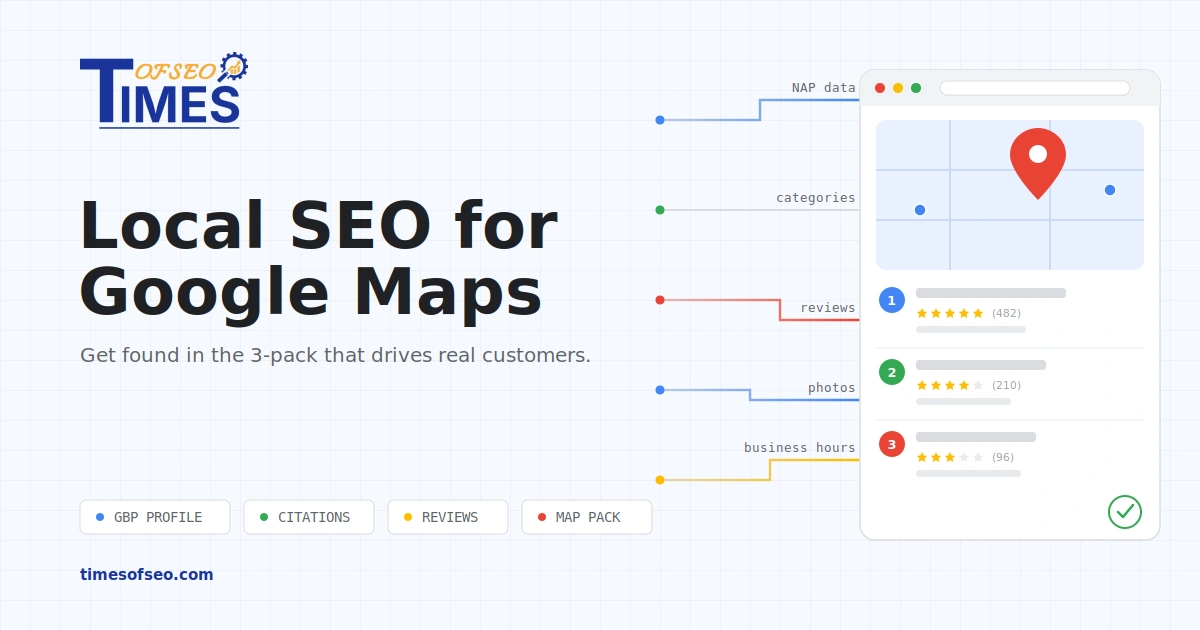
Most small business owners assume a good website is enough to get found online. It isn’t. Local SEO is the practice of optimizing your Google Business Profile, citations, and reviews so your business shows up when nearby customers search for what you offer, whether that search happens on Google Maps, a voice assistant, or a plain Google search bar. Nearly half of all Google searches now carry local intent, and 76% of people who search for something nearby visit a business within 24 hours. If your business doesn’t show up in the Google Maps pack or local results, you are losing customers to competitors who do, often before those customers ever land on your website.
The good news is that ranking well in local search doesn’t require a big agency budget or months of guesswork. It comes down to a handful of specific, repeatable actions: a complete and active Google Business Profile, consistent business information across the web, and a steady flow of genuine customer reviews. This article breaks down exactly how to do each of those, with real benchmarks so you know what good actually looks like. You will learn how to optimize your Google Business Profile, build consistent citations, manage reviews, and avoid the mistakes that keep small businesses out of the top 3 map results.
Why Local SEO Matters More Than Ever
Local search has become the primary discovery channel for businesses with a physical location or service area. Data from Bright Local shows that 75% of consumers read reviews before choosing a local business, and listings with 50 or more reviews at a 4.5 star rating or higher have a 61% better chance of ranking in the top spots.
Local SEO typically produces a lower cost per lead than outbound marketing, and businesses that rank in the Local Pack see substantially more website traffic than those that don’t. For a small business with a limited marketing budget, this is one of the highest-return channels available. If your profile is incomplete or your citations are inconsistent, you are handing customers to competitors before they even visit your website.
How to Optimize Your Google Business Profile
Your Google Business Profile (GBP) is the single biggest local ranking factor. Follow this checklist to get it right.
- Claim and verify your listing if you haven’t already.
- Choose the most accurate primary category and add relevant secondary categories.
- Write a complete business description of at least 750 characters. Profiles with longer descriptions receive significantly more impressions than shorter ones.
- Add your services, products, hours, and attributes in full. Around two-thirds of GBP listings are missing at least one of these fields.
- Upload at least 30 photos. Profiles with 30 or more photos win roughly 2.7 times more clicks than those with fewer than 10.
- Post updates regularly. Profiles that post consistently appear in the top 3 map results more often than inactive ones.
- Enable messaging and Q&A if your industry supports it, since these features are linked to higher engagement.
Building Citations and NAP Consistency
A citation is any online mention of your business Name, Address, and Phone number (NAP). Consistency across directories like Yelp, Bing Places, Apple Maps, and industry-specific listings is a confirmed ranking factor.
Keep these points in mind:
- Use the exact same business name, address, and phone format everywhere.
- Prioritize high-authority directories relevant to your industry before smaller ones.
- Audit existing citations quarterly to catch outdated addresses or old phone numbers.
- Consistent NAP data across locations has been linked to a meaningful SEO boost for multi-location businesses.
Small inconsistencies, like listing “St.” on one directory and “Street” on another, can quietly undermine your rankings over time.
Reviews and Reputation Management
Reviews are one of the strongest trust and ranking signals in local search. The average Google Business Profile now carries around 47 reviews, but businesses in the top 3 local results average well over 500.
To build review volume and quality:
- Ask satisfied customers directly, right after service completion.
- Respond to every review, positive or negative, within 24 hours when possible. Fast responders see meaningfully higher review velocity over time.
- Never buy or fake reviews. Google actively penalizes this and it damages long-term trust.
- Use a simple text or email link to make leaving a review effortless for customers.
Every 10 additional reviews has been associated with a small but real lift in profile conversions, so consistent review generation compounds over time.
Common Mistakes Small Businesses Make
- Leaving the Google Business Profile incomplete or outdated
- Using inconsistent business name, address, or phone formats across directories
- Ignoring or delaying responses to customer reviews
- Targeting broad keywords instead of location-specific ones
- Forgetting to update hours, holidays, or service areas seasonally
Conclusion
With local intent driving nearly half of all Google searches, small businesses that optimize their Google Business Profile, maintain consistent citations, and actively manage reviews put themselves in position to win the Local Pack and the customers that come with it. The businesses that show up first in Google Maps aren’t necessarily the biggest ones. They’re the ones that treat their profile, citations, and reviews as an active part of the business, not a one-time setup task.
That means checking your GBP for gaps every few months, auditing your NAP consistency across directories at least twice a year, and building a simple habit of asking for reviews after every job or sale. None of this requires a large budget. It requires consistency, and most competitors still aren’t doing it well, which is exactly why the opportunity is still open for small businesses willing to put in the work.
If you want a local search strategy built around real data and measurable results, the team at Times of SEO can help you get there. Contact us today to get a free local SEO assessment for your business.