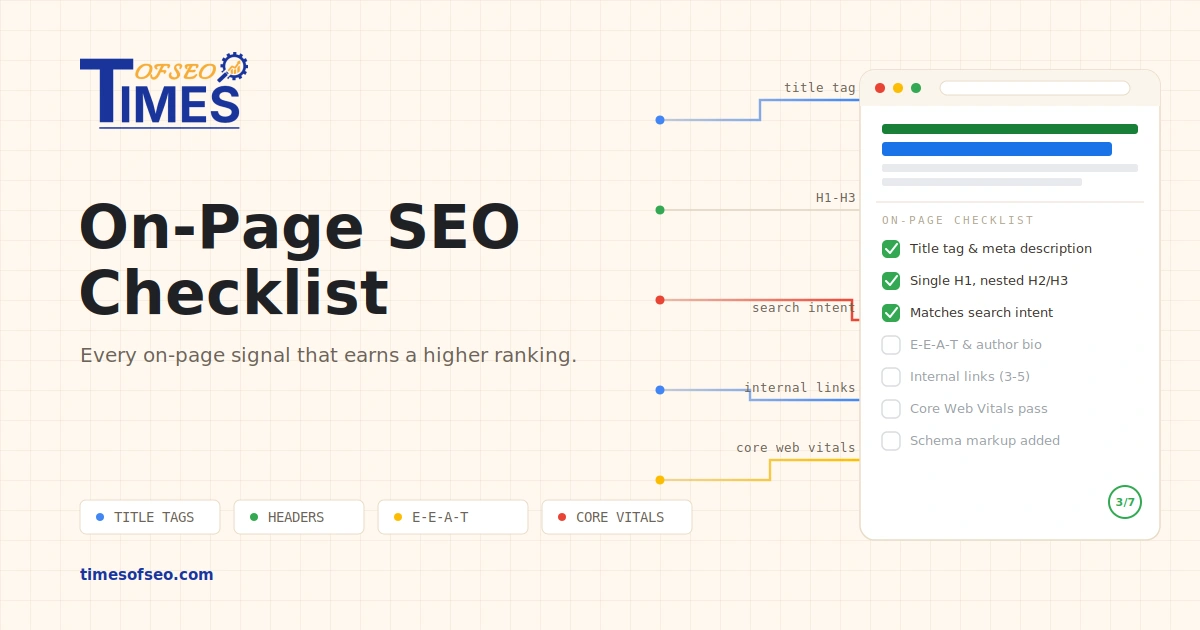
Getting your website to rank on Google feels like a puzzle where pieces keep changing. Many business owners publish great content, yet their traffic stays flat because they ignore essential On-Page SEO signals. Search algorithms do not guess quality. They scan specific structural elements on your page to determine if you deserve the top spot. If your site lacks these core technical markers, your pages remain buried regardless of how well you write.
This guide provides a professional On-Page SEO checklist used by industry experts to climb search results. Drawing from years of hands-on digital marketing experience, you will learn how to optimize your content structure, fix technical bottlenecks, and signal relevance to search crawlers without using guesswork or robotic tactics.
What is On-Page SEO and Why It Matters
On-page SEO covers every ranking factor controlled directly on a webpage: titles, headers, content, links, images, and code. Google’s ranking systems combine hundreds of these signals to judge relevance, quality, and user experience. Pages that address these signals correctly consistently rank higher and hold their positions longer than pages that rely on backlinks alone.
Building a solid foundation through this approach helps search engines understand your exact value proposition within seconds. Many business owners publish great content, yet their traffic stays flat because they ignore essential structural signals. Search algorithms do not guess quality. They scan specific structural elements on your page to determine if you deserve the top spot. If your site lacks these core technical markers, your pages remain buried regardless of how well you write.
How Title Tags and Meta Descriptions Affect Rankings
Title tags and meta descriptions form the front line of your search engine optimization strategy. When a crawler scans your site, the title tag serves as the primary text indicator of what your page is about. Industry data shows that placing your target keyword within the first three words of a title captures a fourteen percent higher click-through rate than misplaced terms. Keeping your titles under sixty characters prevents unwanted truncation on desktop and mobile search results pages.
To optimize your title tags and meta descriptions effectively, apply these practical steps:
- Place your primary keyword near the beginning of the title to signal relevance instantly.
- Keep total title length under sixty characters to avoid awkward text cutting in search results.
- Write clear meta descriptions between 150 and 160 characters to summarize your page.
- Include secondary search terms naturally to capture a wider range of related user queries.
Meta descriptions act as your organic text advertisement on results pages. While they do not function as a direct ranking algorithm signal, a compelling description heavily influences whether a user clicks your link over a competitor. Integrating secondary search terms naturally within this space helps catch related user queries and improves overall click performance.
Why Header Structure (H1 to H3) Matters
Header tags tell Google how a page is organized and which topics carry the most weight. A single clear H1 paired with logically nested H2 and H3 tags is far easier for search algorithms, and AI answer engines, to parse than unstructured paragraphs.
Checklist:
- Use exactly one H1 per page that states the core topic
- Break each subtopic into an H2, with H3 tags for supporting details
- Phrase at least two to three headers as direct questions to align with voice and AI search queries
- Keep headers under eight words and free of filler language
Pages restructured with clear, question-based headers typically see stronger scan-ability, which reduces bounce rate and supports longer average session duration.
How Content Quality and Search Intent Are Evaluated
Google systems are built to match search intent first and keyword usage second. A page that directly answers the reader question in the opening lines consistently outperforms longer pages that bury the answer. Matching the correct content format to what users actually want ensures your site satisfies both traditional search crawlers and modern AI answer engines.
To execute this properly, identify whether the query needs a guide, comparison, list, or product page, and match your layout accordingly. Answer the primary question within the first one hundred words while prioritizing content depth over arbitrary word counts. Top-ranking pages for competitive terms average 1,500 to 2,000 words, provided every paragraph adds genuine value. Refresh your statistics, dates, and examples at least once a year to keep your authority high.
Why E-E-A-T Signals Matter More in 2026
Google evaluates Experience, Expertise, Authoritativeness, and Trustworthiness (E-E-A-T) as part of its quality assessment, particularly for topics tied to health, finance, and purchase decisions.
Checklist:
- Add an author byline with relevant credentials or experience
- Cite sources, studies, or original data instead of unverified claims
- Include a clear business address, contact page, and privacy policy
- Show real client results, case studies, or reviews where relevant
Pages with visible authorship and sourcing tend to earn more trust from both Google’s quality raters and AI-generated answer summaries.
Internal Linking and URL Structure
Internal links help Google crawl a site efficiently and understand which pages carry the most authority. Clean URLs make pages easier to index, share, and reference in AI-generated answers.
Checklist:
- Keep URLs short and descriptive, avoiding parameters or number strings
- Link to three to five related pages using descriptive, keyword-relevant anchor text
- Eliminate orphan pages that have zero internal links pointing to them
- Use a logical folder structure, such as /services/seo-audit instead of /page?id=42
Sites that clean up internal linking generally see faster indexing and improved crawl efficiency within a few weeks of the update.
Page Speed, Core Web Vitals, and Image Optimization
Core Web Vitals are a confirmed Google ranking factor, and slow-loading pages directly increase bounce rate, which weakens ranking stability over time.
Checklist:
- Compress images to under 200KB without visible quality loss
- Add descriptive, keyword-relevant alt text to every image
- Target a Largest Contentful Paint under 2.5 seconds
- Enable lazy loading for images positioned below the fold
Pages that pass all three Core Web Vitals thresholds hold higher average positions than pages that fail even one metric.
Structured Data for AI and Answer Engines
Answer engines and AI-generated overviews pull content differently than traditional search crawlers. Structured, well-labeled content is more likely to be quoted or summarized correctly.
Checklist:
- Add FAQ, Article, and Organization schema markup where relevant
- Write concise, self-contained answers directly under each heading
- Use bullet points and numbered lists for any step-based or comparative content
- Keep factual claims specific and attributable, since vague statements are less likely to be surfaced in AI summaries
Common On-Page SEO Mistakes
Fixing your website code and content structure takes real effort, but small errors can easily derail your progress. Many site owners invest hours into publishing new pages while repeating simple oversights that search algorithms penalize.
To keep your rankings secure and maintain steady organic growth, watch out for these frequent pitfalls:
- Stuffing target phrases unnaturally into titles and headers instead of writing clearly for the reader.
- Ignoring search intent and publishing the wrong content format for the specific query.
- Leaving meta descriptions blank and letting search engines auto-generate a weak snippet.
- Using generic alt text such as image one instead of descriptive, keyword-rich phrases.
- Never updating older content, which leaves outdated statistics and broken links live on your site.
Avoiding these common mistakes ensures your pages remain clean, readable, and fully optimized for long-term search performance.
Conclusion
On-page optimization in 2026 goes far beyond dropping a few target phrases into paragraphs or building external links. Success demands clear title tags, logical header layouts, intent-matched content, visible experience signals, fast page speed, and copy structured for both standard search engines and AI-driven answer engines. Applying this complete checklist across your top landing pages typically produces measurable ranking and traffic gains within a few months, helping your business capture high-intent visitors who are ready to convert.
Getting your website to consistently perform in organic search results does not happen by accident. It requires ongoing adjustments, technical precision, and a deep understanding of what web crawlers and users expect. Stop guessing what works and let your data guide your next steps. Contact Times of SEO today for a comprehensive on-page and technical SEO audit built completely around your specific business goals and your top market competitors.