Technical SEO is the behind-the-scenes work that lets search engines crawl, index, and understand your website covering site speed, mobile-friendliness, crawlability, structured data, and clean site architecture. Skip it, and even great content and strong backlinks will struggle to rank, simply because Google can’t properly access or interpret the page in the first place.
Most small business owners hear SEO and think of keywords and blog posts. But content only works if search engines can actually crawl, read, and index your site correctly. Without a solid technical foundation, even the best-written page can stay invisible on Google.
In this guide, you’ll learn what technical SEO covers, why it has to happen before every other SEO effort, a practical checklist to audit your own site, and the mistakes that quietly hold rankings back.
What is Technical SEO
Technical SEO is the practice of optimizing a website’s infrastructure so search engines can crawl, index, and render it correctly. It doesn’t involve writing content it determines whether your content ever gets a fair chance to appear in search results.
In simple terms, technical SEO answers one core question for a search engine: can I access this page, understand what it’s about, and trust it enough to show it to a user? This covers everything from server response speed to URL structure to whether your site works the same way on mobile as it does on desktop. It also increasingly determines whether AI-driven answer engines and search overviews can read and cite a page at all, since those systems rely on the same crawling and rendering signals as traditional search.
Technical SEO typically falls into a few core pillars:
- Crawlability — can search bots reach and navigate every important page
- Indexability — once found, can the page be added to the search index without errors
- Renderability — does the page display its full content when loaded, including anything built with JavaScript
- Site architecture — is the site organized in a logical, linkable structure
- Performance — does the page load quickly and reliably across devices
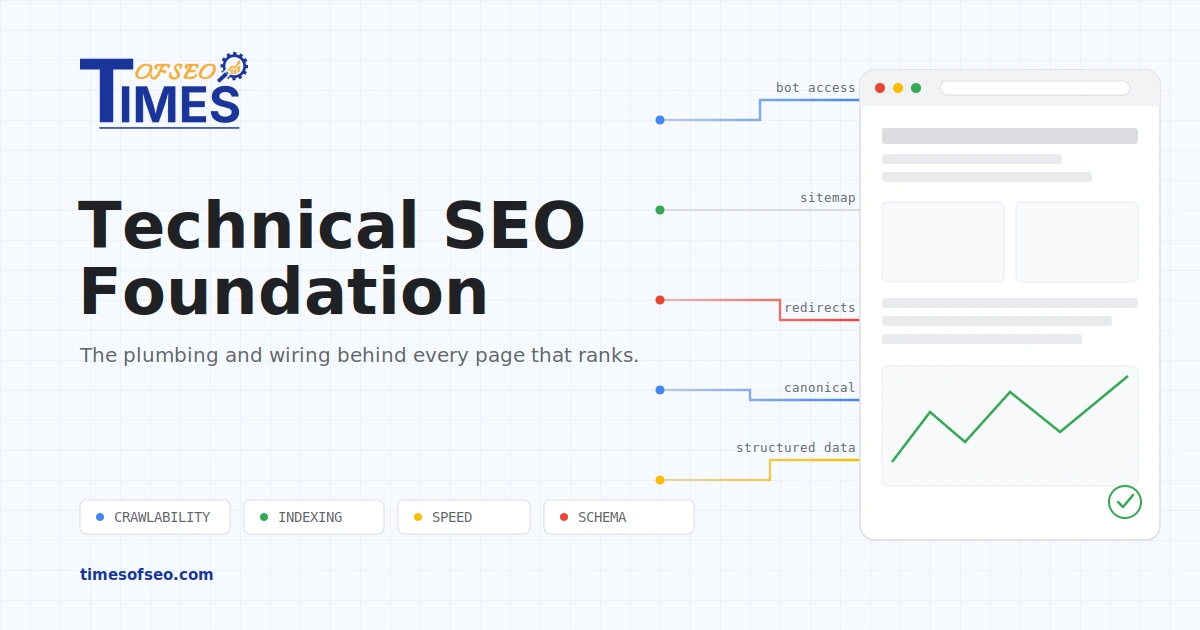
Think of it as the plumbing and wiring of a house. Nobody sees it, but if it’s broken, nothing else in the house works, no matter how nice the furniture looks. Technical SEO is the same: it’s invisible to visitors, but it decides whether all your visible SEO work content, design, backlinks ever gets the chance to be seen
Why Technical SEO Comes Before Content and Links
Search engines can only rank pages they can crawl and understand. If Google can’t index a page, it doesn’t matter how well-researched your keywords are or how many backlinks point to it. Businesses often invest in content and link building first, then discover months later that broken redirects or blocked pages were preventing that work from ever showing up in search results. Fixing the technical layer first protects the return on every SEO investment that follows.
This is also why agencies describe technical SEO as the foundation layer of any SEO strategy. Content and backlinks are ranking signals that tell search engines a page deserves to rank well, but those signals only get evaluated after a page has been successfully crawled, rendered, and indexed. If that first step fails say, a robots.txt file accidentally blocks a folder search engines never get far enough to consider the content or the links at all.
The same logic applies to AI answer engines. Tools that generate AI overviews or chatbot answers still need to crawl and parse a page before they can summarize or cite it, so a technically broken site is invisible to answer engine optimization (AEO) efforts too. A few common scenarios show how this plays out:
- A misconfigured canonical tag points every blog post back to the homepage, so none get individually indexed
- A site redesign changes every URL without redirects, wiping out years of ranking signal overnight
- A page is fully keyword-optimized, but a slow mobile load time pushes it below faster-loading competitors
In each case, the work wasn’t wasted because it was low quality it was wasted because the technical layer underneath it was broken. That’s why a technical SEO audit is the first step in any serious SEO plan, not an afterthought done once rankings disappoint.
Crawlability and Indexing
Search engines use bots to crawl your site, guided by your robots.txt file and XML sitemap. A misconfigured robots.txt can accidentally block entire sections of a site from being indexed.
- Submit an updated XML sitemap through Google Search Console
- Review robots.txt for accidental “disallow” rules
- Check the Coverage report in Search Console for excluded pages
Site Speed and Its Impact on Rankings
Page speed affects both rankings and how long visitors stick around. Sites that load in a couple of seconds tend to keep visitors engaged far longer than sites that take five or more seconds, and that gap typically shows up in bounce rate.
- Compress and resize images before upload
- Enable browser caching
- Minimize render-blocking scripts
Mobile Friendliness and Mobile First Indexing
Google primarily uses the mobile version of a site for ranking. A cramped layout, hard-to-tap buttons, or cut-off content on mobile directly affects visibility on desktop search results too.
- Test key pages with Google’s Mobile-Friendly Test
- Check tap-target spacing on buttons and links
- Confirm text is readable without zooming
Fixing Broken Links and Redirects
Every broken link wastes crawl budget and creates a poor user experience.
- Find broken internal links with a site crawler tool
- Set up 301 redirects for any URLs that have changed or been removed
- Avoid redirect chains, where one redirect points to another redirect
Schema Markup and Rich Results
Structured data (JSON-LD) helps search engines understand what a page represents, whether that’s a local business, a product, a review, or an FAQ. Pages with well-implemented schema are more likely to earn rich results, like star ratings or FAQ dropdowns, which can improve click-through rate directly from the search results page.
- Add LocalBusiness schema to location and contact pages
- Add FAQPage schema to FAQ sections
- Validate markup with Google’s Rich Results Test
Canonical Tags and Duplicate Content
If the same content is reachable through multiple URLs, search engines can get confused about which version to rank. Canonical tags tell Google which version is the master copy, preventing duplicate content from splitting ranking signals.
- Set a self-referencing canonical tag on every page
- Check for duplicate content across www and non-www versions
- Consolidate near-duplicate pages where possible
Common Technical SEO Mistakes
- Launching a new site or redesign without setting up redirects for old URLs
- Blocking staging or test pages in a way that accidentally carries over to the live site
- Ignoring mobile page speed because “the desktop site looks fine”
- Treating technical SEO as a one-time fix instead of an ongoing check
- Adding schema markup incorrectly, which can trigger warnings in Search Console instead of helping
Conclusion
Technical SEO isn’t the flashy part of digital marketing, but it’s the part that makes everything else possible. Before spending more on content or backlinks, confirm that your site is fully crawlable, fast, mobile-friendly, and free of indexing errors. Get that foundation right, and the rest of your SEO investment has a real chance to pay off.
If you’re not sure where your site currently stands, Times of SEO trusted by growing businesses for clear, data-driven SEO strategy offers a full technical SEO audit to identify what’s holding your rankings back, along with a clear, prioritized action plan to fix it.